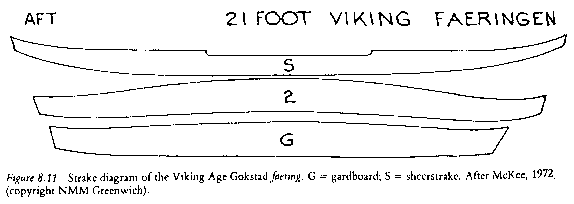
Planks which have been made malleable by steaming or charring may then be forced into position in the boat and clamped there until they set on cooling - usually with some slight loss of curvature; thus it may be necessary to apply some force whilst they are being fastened where the required shape is especially curved as are the second strakes of the Gokstad faering (Fig 8.11) they may be set to cool against a mould of shaped wedges mounted at intervals on a flat board (McGrail 1974: 13).
Softwoods used in northern European boatbuilding may be bent to the required shape by struts from roof and floor and by clamps (Christensen 1473: 142) - see Greenhill (1976: fig. 15) for a similar set-up in Bangladesh in the open air. Where moulds are used they may be used as a fulcrum around which to bend planking.
Fresh green hardwoods bend more readily than when seasoned and softwoods generally accept bending better than hardwoods. These less docile timbers may have to be heat-treated so that they become malleable. Light (but not heavy) frames and other transverse members may be similarly treated to impose a curvature or increase a natural curvature so that they take up the required inside form of the boat. Heat may be applied by heating timbers in a steam box (McGrail 1974: 8-9) or by charing them on one side while keeping the other side wet: for Britain see Leslie (1892: 47 52) for Pakistan Greenhill (1971: 75) and for Japan Greenhill (1959: 5-6). This charring method was known in the ancient Mediterranean: see V. Flaccus (Arg. 1. v. 124, as pointed out by Basch (1973: 332). Curves across the breadth of a plank (set) may be obtained from tangentially converted timber by heating the side nearest the pith whilst keeping the outerside wet thereby inducing warping along the growth rings (MeKee 1983: 53).